
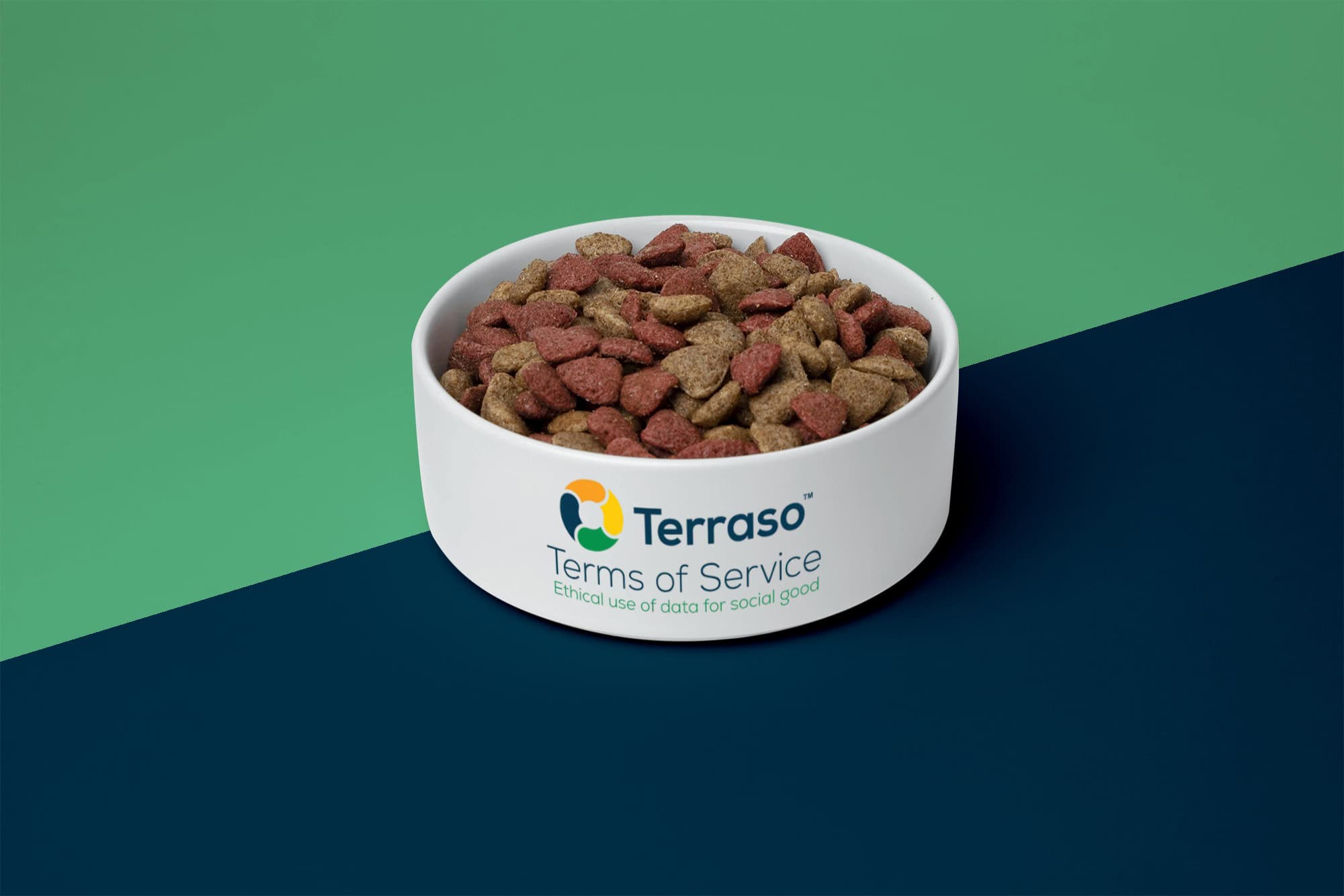
Tech Matters’ newest project is the Better Deal for Data, a set of principles promoting the ethical use of data for social good, modeled after the community consensus approach and social licenses of the open source and Creative Commons movements. The project is still in early development, with draft language available for review and initial prototypes expected later this year. But, when it came time to create a new Terms of Service agreement for our Terraso program last fall, we knew we had the perfect opportunity to test – or ‘dogfood’ – the Better Deal for Data ourselves. In the software industry, the practice of “dogfooding” means trying your own products, ideally long before you ask anyone else to use them. The term came from pet food executives eating their own product in order to demonstrate its appeal!
Terraso is our open source project designed to aid community leaders in pursuing a more ecologically and financially sustainable path. Terraso software tools aid in data collection, visualization, and stewardship, and Terraso Story Maps help communities tell place-based, visually rich stories. LandPKS Soil ID, the latest Terraso app, helps land stewards determine their soil characteristics to guide farming and land management decisions. Each Terraso application captures and safeguards certain data pertaining to the people and communities it supports.
Like most software applications, using Terraso requires users to receive a privacy notice (often referred to as a privacy policy) and agree to certain Terms of Service – documents that define and outline each party’s rights and responsibilities. These terms are typically composed of dense legal language, often spanning many pages (and sometimes requiring a law degree to understand). Take the Facebook Terms of Service: more than 5,000 words, linked to fifteen additional legal agreements!
As we created the Terraso Terms of Service, we wanted to take a different approach. Our goal was to provide terms that were easy to understand, matched the eight draft Better Deal for Data commitments, and remained fair and legally enforceable. We were joined in our dogfooding adventure by a pro bono team of experts from a prominent Silicon Valley-based law firm that represents some of the world’s most innovative technology companies.
For standard contracts such as Terms of Service and Privacy Notices, many law firms maintain general templates that serve as the starting point for drafting these types of documents – suitable for some companies without modification. However, as a small nonprofit technology company building open source software, this was not the approach we wanted to take as it did not align with the Better Deal for Data goals of clarity and transparency. During a five month collaboration, we dug deeply into each important provision, simplifying complex phrasing and inserting plain language titles summarizing the intent of each section. A few examples:
- “Your Feedback is a Gift.” How could we protect our ability to use important user suggestions that help us improve our service?
- “Content Removal is Unlikely to be Complete.” How can we recognize a user’s rights to data deletion, while acknowledging that eliminating every trace of a digital record is tremendously complex and may not be possible under applicable laws.
- “The Services May Not Last Forever.” How would we identify alternatives or provide reasonable notice if some or all of Terraso’s services were to come to an end?
Most importantly, we declared our alignment with the Better Deal for Data directly at the beginning of the Terms:
- “These Terms are Intended to Comply with the Better Deal for Data
It is our intention and belief that our Terms and our Privacy Policy conform to the commitments of the Better Deal for Data (“BD4D”). Since BD4D is still an evolving specification, we welcome your feedback on any aspect of our BD4D compliance.”
Depending on its business model, market category, geographic location, and more, every organization will have a different set of legal complexities to address in their terms of service and privacy policies. We believe that the Better Deal for Data complements these needs, enabling organizations everywhere to provide a shared, standard commitment to responsible data protection. By ‘dogfooding’ the Better Deal for Data principles in our own legal agreements, we were able to learn what practical challenges and conflicts might arise once the project has launched.
Want to see how we did? Take a look at our new Terraso Terms of Service, and tell us what you think!