
Editor’s note: In this episode we revisit the story of Aselo, the open source contact center platform transforming how child helplines operate around the world. Our guests are Dee Luo, Director of Product & Business Operations, and Nick Hurlburt, Executive Director.
Dee’s past work in Product Management includes Yext, a SaaS business software based in New York. She’s a fellow of the MovingWorlds Institute and joined Tech Matters in 2020 to lead product management for Aselo.
Nick began his career developing early AI software at Amazon and later managed software teams at Sift. He spent six years in conflict relief in Burma and South Sudan, capturing human rights, migration, and multi-sector program data.
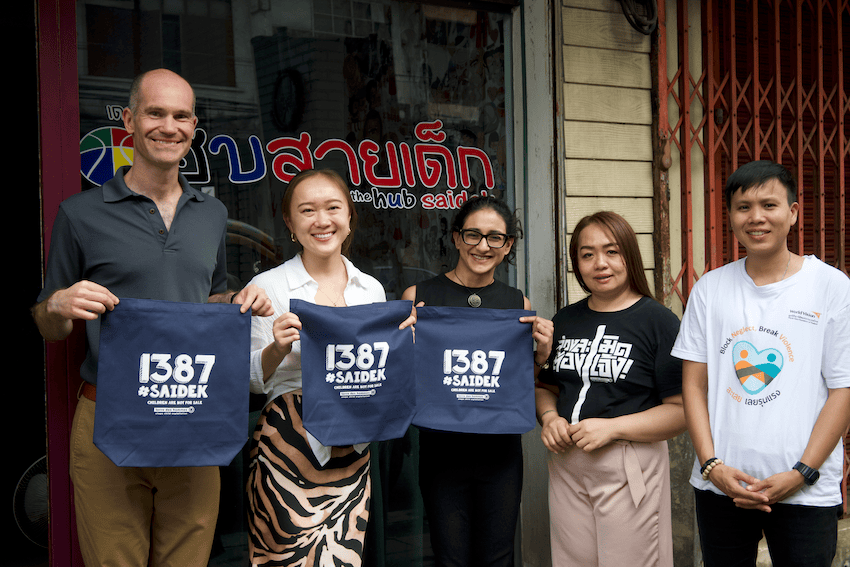
The success of Aselo is demonstrated by its global partnerships, providing with privacy-first technology for children in crisis in more than 15 countries. Among these, The Hub Saidek (see image above, with Nick), which is dedicated to providing support for children and teenagers in Bangkok, and SafeSpot (see second image, with Dee), Jamaica’s national child and teen helpline.





Transcript
Jim Fruchterman
Welcome to Tech Matters, a biweekly podcast about digital technology and social entrepreneurship. I’m your host, Jim Fruchterman. Over the course of this series, I’ll be talking to some amazing social change leaders about how they’re using tech to help tackle the wicked problems of the world. We’ll also learn from them about what it means to be a tech social entrepreneur, how to build a great tech team, exit strategies, the ethical use of data, finding money, of course, and finally, making sure that when you’re designing software, you’re putting people first.
Earlier in 2025, we ran a special episode for Podcasthon, a global event where over 1,500 podcasters from 40 countries each told the story of a nonprofit whose work they wanted to share with the world. We’re bringing back that episode today as part of Season 3, as it’s dedicated to one of Tech Matters’ very own social enterprises, Aselo, led by the wonderful Nick Hurlburt and Dee Luo. Asalo came about because one of my long-term social entrepreneur friends, Jeroo Billimoria, asked for help for the Child Helpline Movement, which she helped found. Stick around after the interview for some of my additional thoughts about where technology fits in with children’s rights, especially as we use more technology like AI.
—
Dee, Nick! Welcome to the Tech Matters podcast.
Dee Luo [01:37]
Thanks, Jim. It’s great to be here.
Nick Hurlburt [1:39]
Excited to be here, Jim. Looking forward to it.
Jim [1:41]
Why don’t you tell us a little bit about what Aselo is, and then we’ll go a little bit into the backstory of what brought you to a tech for good nonprofit.
Nick [1:54]
So Aselo is a contact center platform for all manner of helplines, for child helplines, for crisis helplines, or hotlines. And the goal has really been to provide something that is specifically built for the needs of helplines.
Ninety-five percent of the contact center software out there is really geared for sales and support. So one of my examples is you call up an airline to get your flight changed. They have a whole system that they’re using to be able to take that call, to manage it, to make the changes in their system, whereas helplines have a different issue: They are also taking calls and texts and chats, but their goal is to provide counseling, to provide support, to provide resources. And that’s just a very different use case that isn’t really attended to by some of these other platforms. So what we set out to build, working in partnership with Child Helpline International, was something that could really meet that need, and meet it really at a global level for all of these different kinds of helplines coming from many different countries, but who actually have 80 to 90% of their use cases and their needs are more or less the same.
Jim [3:15]
Cool, so, and Dee, among other things, you drive product management. So could you share a little bit about who is the user and how did they experience Aselo and how does that make their social good mission, their work, more effective?
Dee [3:30]
Yeah, definitely. So Aselo is being used by helpline staff. So that could be a counselor, and a counselor could be a social worker, a psychologist, someone who’s providing that service to the health seeker that’s reaching out to the helpline. Or that could also be a helpline manager or supervisor, someone who’s overseeing the program and needs to do reporting or quality assurance on the level of service that’s being provided. And so, you know, maybe more non-technical folks, right?
Again, they’re really trained in and are experts in how to provide that human to human care element that people are seeking when they reach out to helplines. Keeping the user in mind and those users in mind when we think about developing the platform is really, really important. And we try to make every feature that we build into Aselo a direct request or something that is directly in response to feedback that we’ve heard from our users.
Jim [4:26]
So, so tell me a little bit about like, what did they experience? What does Aselo look like?
Dee [4:31]
So Aselo is a web-based, cloud-based platform that helpline staff can access just via a Google Chrome browser. They don’t have to download anything. They just need a computer connection, and they’re able to access what they need to do their jobs and their shift. So when they log into the platform, they just get one simplified interface. And the idea is that they can handle all of the inbound conversations that are being sent into the helpline. So they can handle all the inbound conversations, and then they can also do all of the data entry and all the potential admin that comes alongside doing those kinds of conversations. So it’s one interface where they don’t have to be switching to different tabs or opening different systems to do their jobs. They can kind of do everything from one place.
And for the channels that are supported, I think this is a good example of maybe how we have had to purpose build again to the groups we work with. We support voice calls and texts and chat, which tend to be somewhat typical now for call center solutions. But we started working with child jelplines, and child helplines are concerned about where children are and what are children using. They’re using platforms like Instagram. They’re using platforms like WhatsApp and Telegram. And so part of building Aselo was also building in some of those social media channels so we can meet help seekers where they are. And so in Aselo, counselors can take voice, texts, Instagram, Facebook, WhatsApp, Telegram, potentially more that we’ll add in the future from the same interface that looks the same regardless of what channel that conversation comes in.
Jim [6:09]
And of course, one of the things that the helplines really needed assistance with was moving from being 95% telephone oriented to adding these techs capabilities because the average young person is texting a lot more.
Let’s hear a little bit more about your backstory. You guys are both out of the tech industry. You could be working at big companies or maybe you have worked for big companies. So I want to hear more about your journey to working in technology for social good, for choosing to come to work at a nonprofit.
Nick [6:46]
Sure. Well, I, you know, my background in college was in computer science. And I also had a desire to, you know, get involved in social impact and do things that were helping the world to make to be a better place. And my initial job at a college was at Amazon, which was in many ways, a great experience. But there was that sort of sense of what is the what is the social impacts, like I want to be able to sort of do more. And I ultimately thought, I think I need to actually leave the tech industry to be able to do things like this.
And Jim, you were doing Benetech and other stuff was going on, I didn’t know that these existed. And so I went in a completely different direction. And I worked in sort of international conflict relief. I was in Asia, I was Africa, over the course of about six years, and involved in things that weren’t really specifically technical, but we’re working with internally displaced people. And some of it involved data and recording human rights violations and things like that. But eventually, working within international NGOs, and seeing that the ways that they were handling technology, we’re doing things like emailing spreadsheets around, I sort of this revelation that maybe there are actually ways that I can contribute, given the technology background and abilities that I have in a different way.
I then moved back to the United States. I worked at a machine learning startup for a while. And then through a mutual connection ended up meeting Jim. And after a few conversations, as Jim, you were starting to get the program which held the helplines off the ground, we ended up connecting and things went from there.
Jim [8:50]
Well, that’s a great story. And of course, Nick doesn’t always tell all of the story. I mean, Nick’s original job at Amazon included being on the original recommendation team, which was one of the early AI sort of applications where Amazon used it to figure out if you like this book, you might like this other kind of book. And of course, Nick, you came in essentially as the first engineer working on Asalo. And then you became the engineering director. And now you’re the executive director. And this story of people starting at an entry-level position and then quickly moving up into senior management is not Nick alone’s story. It’s also Dee’s story. So Dee, why don’t you share a little bit about what brought you to Tech Matters and Aselo?
Dee [9:45]
Sure. Yeah. So I had been working for a couple of years at a tech company based on New York. It’s called Yext. It was a digital marketing software as a service platform and was working there as a product manager and had kind of moved my way around the organization, started operations and really got to learn so much about how software as a service businesses run operationally and all the different sales, marketing, engineering, implementation, professional services, like how all those things kind of work together to deliver a product.
Also have a background in engineering. My college degree was also in engineering, so very much a problem solving skill set. I always get interested in the nonprofit space. I think something I always thought I would get involved in kind of growing up and going through college, but then getting an engineering degree and I think looking at job options really felt like I had a mismatched skill set maybe to go into nonprofit. I had this idea that to work in nonprofit, I had to have experience with grant writing and maybe policy. And that was not really where a lot of my training had come. And so I think the first one of the first kind of aha moments I had around this is when I was just looking for volunteer experience with nonprofits. I had found Crisis Text Line, who is one of our peers and signed up to be a crisis counselor for them, which is just a remote texting volunteer position. And I remember being really floored by this kind of intersection between tech and nonprofit. That was my first, I think, click to be like, oh, this exists out there somewhere in the world. And so in looking for jobs and kind of putting myself through kind of more professional development and programming, I started to focus more on trying to find like, where can I find this intersection where I can bring my skills and I can bring my tech background and still apply that in this nonprofit world that I want to get more involved in and be a part of. And so I was just on job boards, like Idealist and Fast Forward. Fast Forward has a great job board for tech nonprofits. And that’s where I found the job posting for Aselo. And I applied to be, I guess, the first official product manager after Joan and wasn’t really quite sure what it would look like, but it ended up being really this perfect kind of intersection of me being able to bring our product manager skills for this really important cause.
Jim [12:17]
Well, one of the things that I explain to people who want to do tech for good is your two key hires is basically someone to lead engineering and someone to lead product. And that’s obviously why you guys are on this podcast because the two of you really have built this social enterprise from scratch, right? I mean, Joan and I were there to help with fundraising and making some of the connections, but really you guys built a sale loan to what it is today.
So obviously we started in Africa and I think the technology we had back when we launched it was a big improvement for our partners. But I don’t think we were Salesforce quality as a start, but now we’re serving countries at every level from rich countries to more developing countries. So Nick, I think it would be great if you could expand on a couple of things. One is open source. So for example, when our partner in Canada Kids Help Phone helps support us to build a new feature, how do other people access that? And then also the importance of data and why does it matter? Because when we’re talking about empowering humans to help other humans, where does the data come in to make basically that empathetic human process actually work better? How do we do that?
Nick [13:43]
Sure, so Aselo is open source and all of our all of our sources out there to look at and not necessarily because we imagine that there’s going to be a bunch of developers who are going to jump into helping to build this table and maybe some but part of that is just the transparency and being open about what we’re doing. And then part of it is that any new developments, everyone gets the benefit of those. So it may be that a particular helpline or another organization wants to fund a particular feature. Everyone then gets the benefit of that both because it’s it’s available, like it’s out there to see, and because it’s built into the platform in such a way that it’s useful for everyone.
So it ends up being sort of a community project around contributing things in. And another aspect of that is I think Dee and other people in our product team think I’ve done a tremendous job of taking the needs of what specific help lines want and thinking about how can this be done in such a way that it’s useful for everyone. Most of the things that we built now are used not just in one place, but in multiple different help lines in that world. Data has always been one of the central aspects. I think, you know, Jim, in some of the conversations with Jeroo and in some of the conversations with helplines, one of the pain points that surfaced was that they would provide aggregated, anonymized data to Child Helpline International. And it was a very painful process kind of for everyone involved because they had to provide a standard format. Helplines often had data in multiple different systems that didn’t match that format. And so there’s just always kind of a real pain to do that. And it’s not just the data for CHI that they’re providing. They have data for their national governments or for donors or for internal use just to try to understand what’s happening. And so there’s kind of both the value of data for operational usage as the helpline is trying to plot out what are both the staffing levels and the training and different things that they need to be paying attention to as well as advocacy purposes. How can they get the message out about what’s going on with kids or with other people, mental health challenges? How can they sort of create sort of assistance change or a policy change around helping to prevent some of these issues and other things that are coming up? And so with Aselo, we are doing good practices around structured data. First of all, making sure that data is secure, making sure that we’re complying with appropriate privacy standards and regulations. And then also having that data in a state where it can be shared in different formats after being anonymized, aggravated, and being able to provide that back in a way that’s valuable and that helplines have access to it and the helplines own their data. So they get to choose what they want to do with it.
Jim [17:05]
Well, that’s a really important part. I think that upgrading the data capabilities of helplines by a shared tech platform that kind of works on their common issues has been a huge benefit that I’ve heard a ton about from leaders of helplines.
So no conversation about data is complete without a conversation about AI, which is a constant issue. I’ll note that a lot of our job is to tell people as of the date of this recording in 2025, it’s not ready to fire your counseling staff and replace it with a robot chat bot.
Nick [17:46]
So typical helplines, counselors will have a phone conversation or a chat conversation, and they will be recording a bunch of data about that conversation. But a lot of them spend a lot of time adding in that information, and that time could be spent taking another call, talking with another person.
And so we tried to look at how are there ways that we could use AI to help facilitate that as the initial step, and then there’s a whole bunch of other things that we could do. So we’ve looked at the possibility of categorization. So generally all helplines when a contact comes in, they will categorize it, was this mental health issue, was this anxiety or depression or violence or something like that. And they have to categorize these to doing that. And then also they generally have to provide summaries or notes. And so one thing that AI can do is take a conversation and attempt to summarize it. So those are the things that we initially identified, and those are the things then that we’ve been working on.
And before we did any of this, starting to work on these projects, first thing that we did was talk with helplines and get their agreement to use data for that. We didn’t initially have agreements that allowed us to do that with helplines. And so since they own their data, we said, here’s what we’re going to do. This is how we’re going to use it. We want to make sure that you’re okay with that.
Another big part of it was scrubbing it for personal information. So removing names, places, other things like that before we start working with AI on it. And that’s for a couple of different reasons. One of those is protecting people’s privacy, making sure that if we’re using that in any way, there isn’t a risk with that leaking in some way. Another aspect is to avoid bias. So we’re not training AI based on someone’s first name or anything like that, where that could actually add some bias and some error.
So once we had that as a data set, we started experimenting with different things and really engaging with our helplines throughout that process. And I may actually offer to Dee that sort of talks through the process of sort of doing the user research and other aspects of that.
Dee [20:12]
Yeah. I think on the user research side, two kind of areas I think we focused on is one, again, trying to focus on what are the pain points that we can solve with technology and with AI and not starting the other way around. Not saying, oh, here’s a fancy use case of AI. What do you think? We tried much more to understand what are these counselors’ workflows? Where are they maybe getting stuck? Where do they have challenges? And it’s not the same for a counselor working in Zambia and a counselor working in New Zealand. Each counselor’s experience is going to be a little bit different. Each helpline has different protocols around how they capture data and they have different operational policies, things like that. So doing the user research was a really important step to make sure we understood what problem were we actually trying to solve and what can we build that’s going to enhance the counselor’s experience and not create more friction around it and more confusion.
And then I think the second element that we really wanted to understand was, will these counselors trust AI in terms of seeing it in their platform and seeing the results that are generated from it? And resoundingly with the answer was yes. Obviously, there can be a little bit of hesitation, but I think overall, once the counselors get to see their work reflected in the technology, I think there is a trust and there is a knowing that AI is being used out in the world. And we had some counselors who had their own really great ideas about how they thought they wanted to see AI in the platform and how they wanted to engage with it. So kind of being able to hear their ideas, their voices and get kind of a pulse on their comfort around AI, I think was really important.
Jim [21:49]
Well, Dee, I mean, bringing up trust, I mean, we’re being entrusted with this super sensitive data. We’re being entrusted by building the key infrastructure for these organizations. And so an awful lot of our work is about being trustworthy. And that creates the opportunity for us to make a difference in partnership because we’re the toolmakers and the helplines are the ones that are actually helping people on the ground.
So I think one other point I want to make about this is that there are a lot of people working on AI in our field. We’re releasing our open source, releasing the data, the sensitive data, but sharing what we are finding out as we do it. And that’s really quite unusual. And I think the nonprofit sector needs more of that because, frankly, the use cases across much of the helpline field when it comes to AI are kind of similar. We should be working together as opposed to in tiny little silos. But as we get ready to kind of wrap up the story of Aselo and the story of you two leaders, I think you both have observations, learnings, challenges that you’ve been experiencing by doing this work because it’s not 100% easy. And so, Dee, it would be great if you could kind of highlight a couple of the key things that you would like to share with other people about what your experience building this social enterprise as the product leader and the operational leader has actually meant.
Dee [23:27]
Yeah, I think I would go back to what we were just talking about, which is trust. And I think that that has been a really key part to our success, and I think that is something that has really almost set us apart. And I think, you know, when we speak to helplines, whether or not they use a sale, I think something that we just consistently see is people don’t trust the sofa they’re using. And when they don’t trust the software, there’s almost like a hostility, there’s a resistance to being able to kind of figure out how we can build something together. And I think continually making sure that we’re earning that trust and keeping that trust is really important.
And I think we do that with our relationships. I think we do that by really putting a lot of care and showing a lot of empathy for the missions that each of these organizations are putting forth. And so, you know, I think, again, hiring people on our team who really understand the importance of that and prioritize that helps us maintain these really strong partnerships with our with our helpline partners. Working internationally with a fully remote team, both allows us to sometimes meet our partners where they are, because we have kind of more regional coverage, but it’s also a challenge because we can’t have people, you know, all over the world in every place that we work either. And so I think there is this balance. I think one of the challenges we have experienced is working with a small team and supporting, you know, very big range of time zones and making sure that people feel like we are there and supporting them, even if it’s the middle of the night for our most of our working team. Definitely been a challenge, but I think something that we are continuing to work towards and build around.
Nick [25:15]
Yeah, I would certainly agree with everything that Dee said. You know, I think when people ask me what it’s like to work at a tech nonprofit versus a for-profit organization, I think I’m quick to say that there is a lot more that is in common than you realize. And we’re organized in similar ways. We have product teams, we have engineering teams, we have sprints, we have planning, we have all of this different stuff that factors in. It’s a lot but similar.
I think that some of the differences, like of course the trust in that sort of community building, I think is really important. I think we, it’s good to be in a field where the other organizations and peers in the field are more collaborators than competitors. There are in some cases situations where we do compete, but it’s much more collaborative in people working together to solve a common problem. And I would much rather work in that sort of environment than in a really tight, competitive situation. One of the aspects as well is just that the way that things are funded can be very different, which creates situations. A lot of times there is restricted funding. So there’s like, we’re being funded to do a specific thing that doesn’t include these other things. And that often misses out on some of the things that are really core to having a tech organization function.
As someone with an engineering background, one of the things I harp on all the time is just technical infrastructure. People are really excited to fund the shiny new features, but then some of the boring stuff keeps everything running, isn’t great. And we are thankful that we do have some tech forward for donors who have helped out with that. But I think another factor is as we are doing more in sort of the earned revenue side and trying to build a sale as a more sustainable organization that relies on both combination of grant funding and earned revenue, then sales and marketing ends up being a thing that we need to do. We need to put effort into that, which is also a thing that it’s hard to find funding for when you’re not providing any sort of a monetary return on investment. So I think those are some of the things that a lot of nonprofit organizations work with that we have to wrestle with as well.
Jim [27:53]
Well, I think you described a very ironic situation. I mean, last year, Aselo was more than 50% of its revenue came from our customers.
If a for-profit had reached that point where it was generating cash flow and product market fit, they would go out and raise a boatload more capital because investors would say, oh my god, they have a product. They have distribution. Let’s help them grow. And this is the moment for organizations like ours that we have donors going, well, we funded you already. We’re funding somebody else. And with some noteworthy exceptions, which as Nick, you know, we’re very appreciative of those people. Well, this has been really exciting. And I think that I’m looking forward to doing my part, which is helping us raise a lot more money to fill those gaps so that a salo can grow from 15 or 16 countries to 20 or 30 and keep seeing that the people who are helping other people are a lot more powerful in their work by having modern tech tools that actually work, safeguard the data, and can be used to advocate for larger change at a systems level. So thanks for building this incredible solution. And I hope it just goes from strength to strength.
Nick, Dee [29:20]
Thank you, Jim.
—
Jim [29:24]
Thanks for listening to my conversation with Dee Luo and Nick Hurlburt from Aselo. I’d like to take a moment to highlight something Dee and Nick said about trust. Helplines entrust Aselo with their core operations. Help seekers entrust helplines with their most vulnerable moments. That chain only holds if every link behaves in a trustworthy way.
In the for-profit sector, we treat trust as a marketing problem, but really it’s a governance problem, a power problem. Who owns the data? Who sets the policy? Who decides what AI can and can’t do? And how transparent are we when things go wrong? What I love about this story, the Asalo story, is that it shows a way forward. Open source code, local ownership of data, and a nonprofit partner whose incentives are aligned with social impact rather than growth at all costs. That doesn’t magically solve every issue, but it gives us a healthier starting point for the social contract around technology, especially when the needs of children are hanging in the balance, which of course brings us to children’s rights.
Not nice to have rights, but the basic ones in the UN Convention on the Rights of the Child. The right to be heard, the right to protection, the right to privacy. When young people contact a crisis response helpline, they’re often exercising those rights in the most fragile moment of their lives, and technology can either help or get in the way. A system like Aselo is, in a way, infrastructure for delivering on children’s rights. It makes it more likely that a child’s voice is heard, documented, taken seriously, and acted upon. But that only works if the technology is designed for their safety and dignity first, not for the convenience of the software developer or the donor.
So when we think about innovation, I don’t get excited about AI features on their own. I get excited when I see technology reinforcing those fundamental rights or making it easier for people to protect those rights, especially for kids who don’t have any other safe adult to talk to.
—
If you’d like to learn more about Aselo, visit Asalo.org. That’s A-S-E-L-O.O-R-G. To find out more about what we do at Tech Matters, head to TechMatters.org, or look for Tech Matters on YouTube and or LinkedIn. And if you have thoughts, questions, or guest ideas, you could always reach us at [email protected].
We’ll be on a holiday break until January 7th, 2026, at which point stay tuned as we come back strong with Rikin Gandhi of Digital Green, a very successful social enterprise that’s using generative AI to provide over 8 million farmers around the world with real-time advice and knowledge sharing.
If these conversations resonate with you, I’d love for you to check out my new book, Technology for Good, How Nonprofit Leaders Are Using Software and Data to Solve Our Most Pressing Social Problems, from MIT Press. You can find links and more at Fruchterman.org.
I also want to acknowledge the help of the generous donors who support us, especially Okta for Good. I’m your host, Jim Fruchterman. Thanks for listening.