
People Who Depend On Rangelands Need A Better Deal For Data
Rangelands – areas of land used to sustain livestock – occupy the intense focus of many different interest groups. Depending upon whom you talk to, a rangeland may be a critical source of income, a front in the global battle against desertification, a public resource, a food source, a family legacy, or some combination of all of these. By some estimates, rangelands make up about half the world’s land surface, and yet they are, in the words of environmental economist Professor Nathan Sayre, “embattled, imperiled, and poorly understood”. Data about rangelands are not always available to the stakeholders who need them, in part because barriers exist to sharing information.
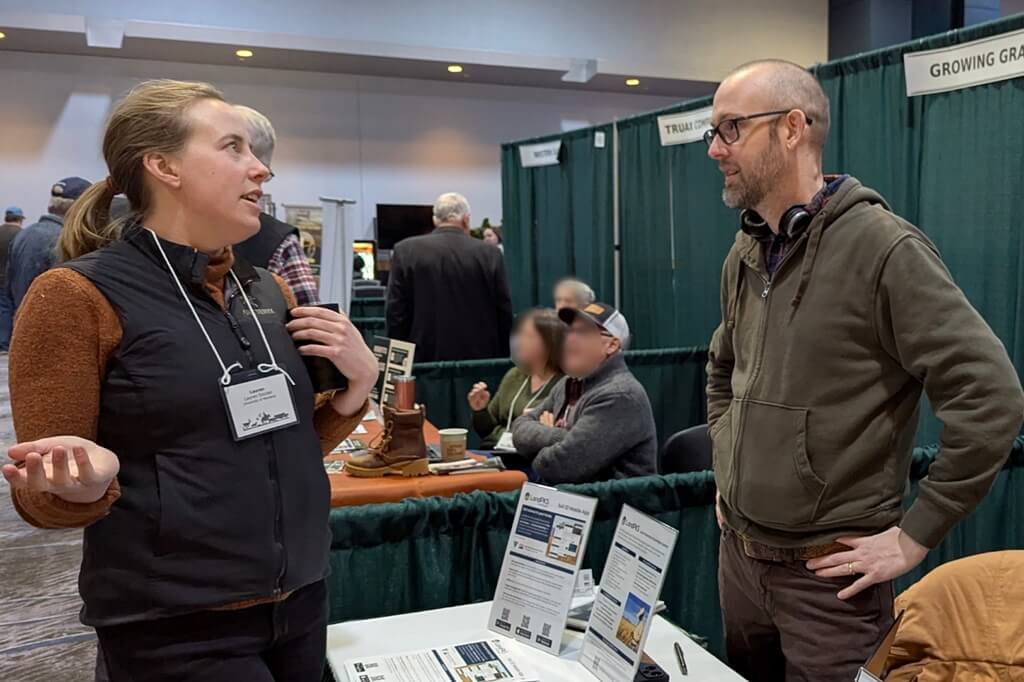
In February, my colleague Courtney Tiberio and I represented Tech Matters at the Society for Range Management (SRM) annual conference in Spokane, Washington. Our goal was to talk about data with the network of practitioners who manage and depend upon the data emerging from rangelands, as part of our lightweight data governance project, the Better Deal for Data. We spoke to scientists, representatives of government agencies, consultants, professors, and of course, producers, the ranchers who maintain livestock in rangelands. Below, I share some of the things I learned at SRM and how the conversations will help shape the Better Deal. And of course, we were also promoting the newest release of LandPKS, our soil science application, which is why we’re part of this community.
What is rangeland data?
Imagine a rangeland – broad fields, hills, and grazing animals – and one might assume data about rangelands are sparse. In reality, rangelands are a rich source of information. At the SRM conference alone, we participated in discussions about:
- Indicators of rangeland health
- Statistics on livestock, climate, and soil health
- Metrics about the seeds, fertilizers, pesticides, and other elements introduced into the soil
- Algorithmic models generated through analysis of large quantities of raw data
- And many more…
Each of these categories of information touches on critical parts of people’s lives. Monitoring data helps land stewards, producers, and scientists alike understand whether their management approaches are working. Ground-truthed, validated information about the land can train powerful predictive models and inform products people use to make decisions every day. Processed correctly, rangeland data has vast economic, environmental, scientific, and social value.
Rangeland data stakeholders come in many forms
While at SRM we encountered many groups of rangeland stakeholders, many who relied on the flow of data to make decisions in their work. Both explicitly and implicitly, people shared questions about how they can maintain their data. A few examples:
Producers
Ranchers need timely access to information in order to make informed decisions, such as the number of livestock they should maintain on the land, and the patterns by which to move them. These decisions are impacted by weather patterns, economic forces, and the current status of their own land. To make decisions, producers rely on a variety of services that merge third party data with their own. How can producers use these services and trust that their own information is used responsibly?
Service Providers
Land Stewards rely on third parties, such as consultants or technology companies, for many services within a rangeland. From monitoring the health of the land and livestock, to purchasing fertilizer and seeds, to training on management techniques, service providers require access to data to deliver the value add that is their bread and butter. How can service providers maximize the value of their services while using data responsibly and maintaining the trust of their clients?
Land Coalitions
Rangelands don’t exist in isolation. Producers exist within communities that benefit from sustainable land practices, including nonprofits, community development groups, scientists, and members of government. Sometimes these take the shape of formal coalitions, collectives seeking prosperity for their constituent members and a healthy ecosystem. These groups coordinate member activity, seek shared financing, and, critically, gather data about the activities and impact of rangeland management. How can such a coalition pursue its goals and maintain the trust of members who share their data?
“For producers, sharing data can often threaten their privacy and livelihoods.”
What challenges exist to the responsible flow of rangeland data?
Information sharing enables all sorts of valuable experiences, from training AI models to helping an experienced producer make their daily decisions. There are many reasons, however, why data stakeholders in rangelands do not want their information to be shared, or at least, want to establish restrictions on how and when that information gets shared.
A single point of data can have multiple, often quite sensitive, meanings. For example, the number of cattle in a rangeland can speak to the pressures upon the grasses and vegetation; it may also be an indirect measure of a producer’s wealth. Rangeland vegetation health indicators measure the success of a producer’s range management strategy and the impact of drought; it can also be a make-or-break data point that will determine whether a critical lease will be renewed. For producers, sharing data can often threaten their privacy and livelihoods.
The free flow of information comes with risk that someone with opposing interests might use that information against you. Decisions that impact people’s lives have the potential to result in conflict, even legal battles. Rangeland data can touch upon hot button issues like environmental health and a producer’s well-being. A producer who shares rangeland data, or a government employee with an obligation to publish data from science on public lands, often worries that they may provide fodder for a litigious group whose interest is impacted.
Some entities see the value-add of their rangeland data as a zero-sum game: “If someone else benefits from my data, it means that I did not”. Many companies operating in rangelands employ a business model that revolves around collecting, analyzing, synthesizing, and in some cases, making recommendations based on rangeland data. This is especially true for monitoring organizations and labs that make land management recommendations. For these organizations, their data is the ‘secret sauce’ – the more they have of it, the better they are able to model and make recommendations. Sharing unique, difficult-to-gather, proprietary raw data is often against the interest of an organization that would benefit from developing unique products from it.
These and other challenges explain why rangeland data is not always free-flowing, despite the fact that many people would benefit from shared access to detailed information.
Data concerns like these are why we are building the Better Deal for Data
Our conversations at SRM contributed to our research on opportunities and challenges around data sharing. It is clear that sharing data could help our overall understanding of rangelands and how to best preserve them, but that any data sharing system needs to start with data stakeholders feeling they can trust the data sharing process to help and not hurt them. Discussions like these help us to build the Better Deal for Data, which we believe can help data sharing partnerships establish that trust.