
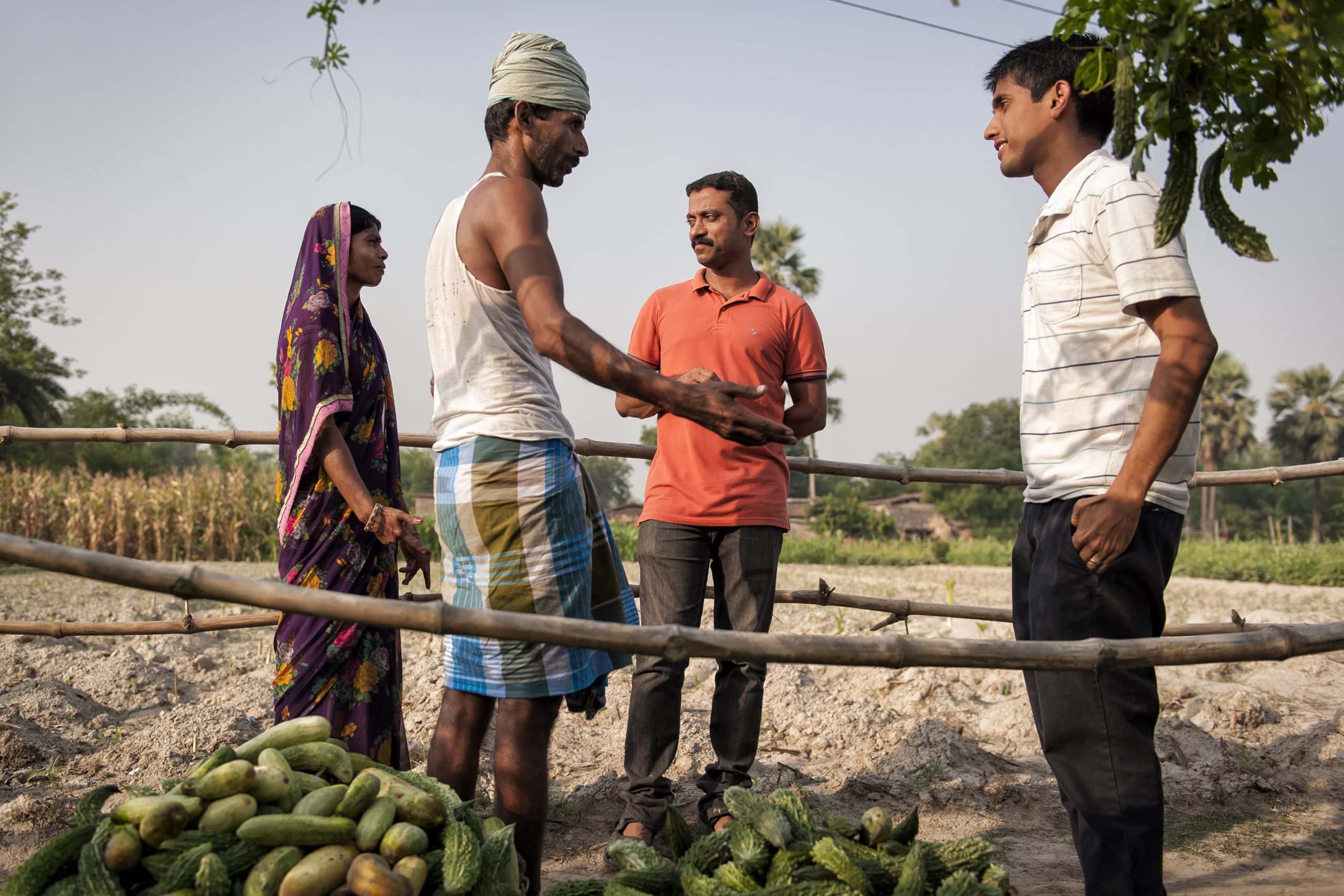
Editor’s note: As you’ll hear, Rikin Gandhi and Digital Green’s approach to technological development is built on solid relationships with a range of institutions. Public administration, culturally embedded nonprofits, and open source software models are all key ingredients in achieving impact at scale. If even just one of these ingredients is missing, the impact will not be the same.
Of course, this complexity comes with its challenges. But it’s clear that government programs, capable of raising individual projects to largescale impact, and local organizations, who are operating on the ground and are therefore in touch with the real issues, ultimately depend on each other. Add in digital technology platforms, developed by leaders like Rikin, and the results will speak for themselves.





Transcript
Jim Fruchterman
Welcome to Tech Matters, a biweekly podcast about digital technology and social entrepreneurship. I’m your host, Jim Fruchterman. Over the course of this series, I’ll be talking to some amazing social change leaders about how they’re using tech to help tackle the wicked problems of the world. We’ll also learn from them about what it means to be a tech social entrepreneur, how to build a great tech team, exit strategies, the ethical use of data, finding money of course, and finally, making sure that when you’re designing software, you’re putting people first.
Today’s episode starts with astronauts and ends up in a maze field (AKA a cornfield). My guest grew up idolizing space explorers and he followed in their footsteps with degrees in computer science and aerospace engineering, and even got a pilot’s license. He was on the path to the US Air Force. But then when he looked closely at those astronauts’ biographies, a pattern emerged. They’d see the Earth from above, come home and ask, why is there war? Why is there poverty?
Our guest had his own version of that epiphany. Digital Green started as a research project at Microsoft Research, using farmer-to-farmer training videos to dramatically cut the cost of agricultural extension services. And then later, as an independent nonprofit, working with NGOs and governments in India, Ethiopia, Kenya, Nigeria, and beyond. With COVID pushing meetings online and farmers returning to rural areas with smartphones in their pockets, Digital Green started experimenting with WhatsApp and Telegram bots, and then generative AI arrived.
Let’s dive into the journey of Rikin Gandhi and Digital Green, and what they might teach us about building technology that generally works for smallholder farmers in a warming, resource-constrained world.
Rikin Gandhi [2:05]
Thank you so much for having me, Jim. I’m so excited for this conversation.
Jim [2:10]
Well, I’m glad they were able to get together. Obviously, I’ve been very excited about the work that you’re doing. I often talk about you guys as an example.
So I’m hoping that we can share with my listeners why I find your example so cool and why I think you have a lot to teach other people who want to follow the Tech for Good path.
Rikin [2:28]
Excited to be here and so much to learn even from your own journey, Jim, it’s a real privilege to be on this podcast with you.
Jim [2:36]
Well, great. So my first question is pretty much, you know, what’s a smart tech guy like you doing in the nonprofit sector? So tell us a little bit about how you got to the point of deciding that a tech for good nonprofit was the way that you were gonna move your career and your work forward.
Rikin [2:54]
Well, growing up, I was inspired by astronauts. They were heroes to me who combined brains and brawn, and I looked at many of their autobiographies, and they would study science and engineering and get themselves to space. And so I essentially did the same by following in their footsteps, getting a computer science degree, getting an aerospace engineering degree, getting a pilot license, and about to enlist in the U.S. Air Force. When, while I was in the application queue, I started to look at the second half of these folks’s autobiographies. And what I’d often find is that these astronauts who saw the Earth from this unique perspective from above would often wonder, why is there war? Why is there poverty? And would come back to Earth and try to reconnect with the world and its people.
And so I didn’t get myself fully up there, but I had shared in their epiphany of sorts and had an opportunity to go out to rural Maharashtra with some college friends who were starting up a biodiesel venture and landed up with a very different type of hero, the Indian farmer who produces the second highest farm output in the world.
Jim [4:15]
Well, I think it’s such a cool story because I also wanted to become an astronaut, and also got a pilot’s license and also studied aero-astro, though I wanted to be on the scientist astronaut sort of path, right? But the biggest fight I ever had with my wife was over my desire to go to space. She just did not think it was a responsible choice [laugh]. But anyway, somehow I ended up not doing it either. And part of the reason was, I was like, well, I should get to know the Earth better, right? Because at that time, I’d never been outside the United States.
So cool. So you got to India and went, wait a second, maybe there’s more to be seen on this beautiful blue-green dot in space, right? So you obviously had your degrees. And so did you actually go to work for this biodiesel group?
Rikin [5:10]
I did, yes. I landed in rural Maharashtra to work with these college friends who were starting up this biodiesel venture. Pretty much the moment that I arrived on the ground, I knew that this venture wasn’t going to really last. But for me, it was my first exposure to rural India and agriculture in particular. And it gave me that first opportunity to see that there was this small minority of farmers who saw agriculture as a source of prosperity. They were making money, sending their kids to school. While the vast majority of farmers saw it as a vocation of last resort and were trying to migrate out of it as fast as they could.
Jim [5:55]
And so you found these “positive deviants” really interesting. And so as the biodiesel thing was your exposure to this, but then what happened next?
Rikin [6:06]
Well, I then hooked up with Microsoft Research in Bangalore that had just set up a lab there a couple years prior, and they were trying to explore various parts of computer science from algorithms to cryptography to multilingual systems. But they also recognized that technology wasn’t being applied, in the same way that it was in the global north, in the global south.
And so they created a specific research group called Technology for Emerging Markets to look at different areas from education to microfinance to healthcare, in our case agriculture, and to see is there a role for digital technology that could create some value.
Jim [6:53]
Well, I wouldn’t have guessed that Microsoft Research would be engaged in agriculture, but it happened to be a pretty cool fit, your technical background plus that interest in Ag. So how long were you at Microsoft Research?
Rikin [7:07]
I was there for three years, and prior to my joining, they were working on an initiative that was actually one of the first digitization efforts in rural India. It was supported in 1996 by MIT’s Media Lab, and they were working with a sugar cane cooperative, also in Maharashtra, and they were having hopes of deploying desktop computers and wired internet connectivity as unlocking all sorts of weather, market access, and information needs for these communities.
But fast forward by 2006, MIT Media Lab was out of the picture, the sugar cane cooperative was left maintaining this infrastructure of hardware, and was finding that the maintenance costs were exceeding the initial investment because of all the moisture and dust and other kind of conditions, and all these aspirational dreams that were envisioned in the beginning weren’t actually holding true. They were, the sugar cane cooperative was still using some of the tech, but only for back office processing kind of purposes, for payments and harvest credit types of purposes, and this was a relatively richer type of demographic of farmers, sugar cane farmers in Maharashtra. And so when I joined up with Microsoft Research, then we came up with this idea to say, is there a role for tech for the larger spectrum of farmers? 80% of farmers in India are half acre to one acre farmers and earning two to three dollars a day. What, if anything, could technology create value for that?
Jim [9:04]
So, what was the breakthrough from technology that had kind of aged out? And you’re in a different era technically. So, what was the innovation and did it actually work while you were at Microsoft Research?
Rikin [9:17]
Yeah, well, one of also the sources of inspiration for us was this initiative in the primary school education space called Digital Study Hall, where they would take videos after school of private school teachers in places like Lucknow, in Uttar Pradesh, India, Bangalore, in India, teaching science, math, and English lessons to surrounding slum school kids, and then take those videos to government rural school teachers who could use those videos initially as a crutch in their classroom, but eventually internalize that pedagogy and just become better teachers. And this was found to be really successful, and so we tried to translate that into the agricultural domain, which is totally different with an adult population of farmers, a not set curriculum for the types of issues that farmers are trying to triage, but to have farmers themselves create videos that were by and for their peers and share these videos offline using VCD players and at the time CRT TVs that small groups of farmers could watch together in a facilitated way once a week and ask questions, get feedback, apply practices, and share learnings with each other in this iterative cycle that we found was able to reduce the cost of training farmers from 35 USD through these traditional in-person types of training programs that NGOs and government traditionally run down to 3.5 USD.
Jim [10:57]
Wow, okay, so you’re able to do a tenfold decrease from the cost of training a farmer by exposing them to a video of sort of the local master farmer, that one that is really knocking it out of the park in terms of making a living and figuring out how to make money and all that kind of thing. And you’re like, so it’s basically finding the positive deviant in sort of this area, and video, and then the digital delivery system lowered the cost of actually delivering that training. I assume you’re $35 if you’re doing an in-person training with sort of an ag extension agent doing the class, as opposed to just watching the video with someone not having to have that same skill level. That’s kind of where you got the 10X?
Rikin [11:39]
Exactly right. So yeah, the first question that people ask when they watch these videos was, what’s the name of the person in the video Which village is he or she from to say that if this person can do it, then maybe I can too. And also to create some like non-monetary incentives so that farmers would be incentivized to be featured within these videos of as positive deviants and innovators in their own right. And also, as you said, the main two factors that were driving that cost reduction were these videos by and for farmers that could take a one to one demonstration to many. And then the way in which these were facilitated was by a peer farmer, rather than trucking out an expert or an extension agent from a city center, or some such, and where, you know, relatively few farmers would actually show up and apply the practices that they were exposed to.
Jim [12:36]
Okay, and I think this is really quite common in tech for good is 10x cost reductions is actually possible, right? So, you’ve done this, you’re at Microsoft Research, it seems to be working and it’s probably not on the top 10 list of new products for Microsoft.
So, what happens? I mean, do they kind of like usher you out or say, well, this is Microsoft Research, we’re done now? What was that? What was the denouement?
Rikin [13:05]
Well, Microsoft Research runs almost like a computer science department in a university, and there’s basically two paths after you’ve concluded your research project. Either you have some IP or tech that can be transferred to some commercial product, which we of course didn’t have [laugh], or you publish the results of this paper and study, and you move on to the next research area of question.
In our case, we decided that, well, we actually want to take a third route, which was we’re seeing great impact and efficiency gain value at the farmer level, but also with these initial NGO and government folks that we were partnering with who are running these traditional extension programs, and we decided that let’s spin off, and we became Microsoft’s first nonprofit spinoff.
Jim [14:03]
Oh, wow. And so they were actually supportive of you spinning off because they figured out this is just not a Microsoft business opportunity and the paper had been published.
Rikin [14:13]
That’s exactly right. Yeah, we went through like IP reviews and such to just confirm internally within Microsoft that it was fine. But yeah, it was fine.
Jim [14:23]
Yeah, and so how long ago was that that you started Digital Green?
Rikin [14:27]
So digital being started as a research project at Microsoft in 2006, and then we became an independent, not for profit at the end of 2008.
Jim [14:38]
Wow, okay, so you’ve been doing this almost 20 years and as a nonprofit for over 15. And so, cool, so now let’s chart the cost. So you’re starting a nonprofit, you have a proof of concept that was enough for a research, kind of paper, product. So talk about how you scaled up this basic idea and kind of what path you took to get it to more people.
Rikin [15:05]
The primary path was that we partnered with other organizations that had the trust networks with these farming communities and had the location specific domain expertise. So even in the very beginning when we were a research project at Microsoft, we partnered with a small NGO called Green Foundation that was working on biodiversity conservation, setting up seed banks with farming communities and promoting various sustainable agricultural practices amongst them.
And that’s in fact how we got our name, Digital Green. We were adding the digital layer to this Green Foundation’s work on the ground to make their work which was constrained by money and time and resources more efficient with these videos that were produced by and for farmers. And in a similar way, we ended up being able to scale from Green Foundation partnering with a bunch of great NGOs across India and then taking the attention of some government programs from the Ministry of Rural Development in India to the Ministry of Agriculture in Ethiopia and elsewhere where we would piggyback on the networks and the trust and the expertise that these great organizations who’ve been at it way longer than we have and would train them to produce these videos in a hub and spoke model at a district level or a county level and then have these videos shown, eventually not just with CRT televisions sets but with mobile Pico projectors that would be the hands of these local peer farmers who could then show these videos amongst women’s health groups and other types of farming community organizations and where they would facilitate the screening of these videos, they would engage these communities in an interactive discussion and not just like a passive video show and then record data about who watched what video, what questions they had, what practice that people did not do or did apply on their farms to inform and improve the next iteration of videos based on the needs and interests of these farming communities.
Jim [17:19]
Wow, so there’s a lot to unpack there, right? So you started in, I’m assuming like one state in one language in India, and then you sort of expanded by finding new partnerships, new states in India, then expanding to other countries.
And so, and you’re using these partners both to drive the content creation and the distribution, actually getting to the farmers, and then the data collection to keep making the program better and more effective and fill in gaps and all that kind of thing. So, and so you guys were building the technology and doing these partnerships to get access to the farmers. You’re one step removed from the farmers.
Rikin [17:59]
We were one step removed from the farmers, yeah, and we would create these tools, these training programs, and even like specifications since we didn’t actually procure all this hardware of cameras and projectors, it would often be sourced by these government programs themselves. But yes, we would make sure that this whole system was working end to end to create value at the end of the day for the farmers.
But it was on a day to day basis, the people who would create the videos that people would show the videos was not our staff. That was all these government and not for profit extension programs that already were working and have these trust networks on the ground.
Jim [18:42]
Wow. And of course, what you’re describing sometimes called an asset light approach, right? The expensive hardware, it’s not something you have to find the money for, your partners do.
And you started with NGOs, and then you ended up with government. Did they end up continuing to be roughly equal, or did government swap the NGOs by their reach?
Rikin [19:05]
Yeah, it ended up being that the government took on a lion’s share of the scale. And at the same time, many of these government programs, especially those in India, engaged like the NGOs, there’s sometimes like these symbiotic relationships where even the government recognizes that in some geographies, these NGOs on the ground had much better trust networks and expertise.
So they would partner, they would fund some of the very same NGOs that we had started off with. And in fact, actually, the work that we had been doing with the NGOs is what caught the government’s attention. The fact that they were already partnering with the same NGOs on the ground that we were, gave them some confidence to say that, oh, well, we also are working with those NGOs as well as doing our own thing. And we’d like to apply this approach to improve the efficiency and impact of our work across the board.
Jim [20:03]
So, so obviously you had to find money to do this, at least some amount of money, even though you’re asset light. So who are the main funders for this?
And do you have a revenue model or, or did you have a revenue model?
Rikin [20:18]
So our main sources of philanthropic support from the beginning were groups like the Gates Foundation, the UK Foreign Office, corporate social responsibility programs of big technology companies from Cisco to Google. In terms of earned revenue, we did have some contracts at times with some of the government folks that we were partnered with.
And also, in some cases, with some private sector agri businesses that were also trying to also increase the efficiency of their private extension programs for, for instance, sourcing cacao in West Africa or gherkins in South India. But largely, we’ve been philanthropically supported.
Jim [21:09]
OK, yeah, so so obviously all these videos are getting generated. Are they open content licensed? Are they under Creative Commons?
Rikin [21:18]
Yeah, we have 10,000 videos, 40 languages, all of them are available on YouTube.
Jim [21:22]
Wow. Okay. So this giant intellectual asset, you have a business model, and I’m guessing that something happened, and there could be a number of some things, but something happened to put you in a different direction. So what was that something or some things that caused you to start to shift?
Rikin [21:42]
One of the main things was COVID. So COVID happened and had these physical distancing requirements that basically had a stop all those in-person self-help group gatherings and farmer group gatherings of these video showings.
And at the same time, there was a bunch of urban migration back to these rural communities and many more farmers, including those who were reverse migrating in some ways to these rural areas who brought their phones back with them. And we saw it even on our YouTube channel, wherein we’ve been publishing these 10,000 videos for the last 15 years or so, but hadn’t gotten very many views on YouTube because these are very local language amateur how-to kind of videos. But during the COVID time and beyond, we saw about a hundred million views to these very local language videos as these farmers started to come online. And then as we were trying to navigate through COVID era, we began to play around with deterministic bots on WhatsApp and Telegram that many of these communities were on to create decision trees. So for these farmers to navigate through saying that if I saw a pest, what could be a possible remedy? And then at the tail end of COVID, GPT-3 came out and that was a real game changer.
Jim [23:25]
The first Gen AI chatbot that got common access, right? Was this still a developer tool, or was this like when people started playing and the buzz started?
Rikin [23:37]
Just before chat GPT’s, like, launch, maybe like six months before chat GPT came out but when GPT 3 was already showing a lot of great performance and where we were seeing that the decision trees that we were trying to create on WhatsApp and telegram were really expensive and unwieldy to create and even more cumbersome to use by the farmers because they might have lots of different ways that they might want to enter into a conversational flow. Sometimes they might see a yellowing of their leaf or maybe they might see a pest or maybe they are just looking to know what new variety of a chili crop they should grow.
And what the natural language processing capabilities that really got advanced with this transformer-based generative artificial intelligence models enabled is a huge unlock so that farmers or anyone could ask questions in whatever manner was most intuitive to themselves. And we could create a knowledge base that pertain to their location included videos from their peers that they could relate with and that these farmers could then tap into.
Jim [24:59]
Wow. So the pivot to online happens because of the COVID pandemic, and farmers suddenly are watching your videos on their phones, and then you have a, let’s call it a dumb chatbot or the earlier generation of chatbot.
It was really hard to maintain, and you said, all right, hey, GenAI could be the solution, this new wave of chatbots. But those chatbots are decent in English, but probably not that great in, I don’t know, Tamil or something. So how did you navigate that? What do you have to do?
Rikin [25:35]
Yeah, and in the beginning, as you rightly pointed out, they were even worse for like, you know, agricultural information or languages beyond English. So we started by thinking that we needed to do a lot of training of these systems for languages that were not well represented in these off the shelf models.
We were gathering hundreds of hours of transcription and translation data, and languages like Bhojpuri, which is commonly spoken in Bihar, in India, in Gikuyu, in Kenya, which is a popularly spoken language there. But what we also found out was at the same time that big tech folks, like the OpenAI, Google, Microsoft, Metas of the world, were also investing in also language support and expanding the coverage of their models. And what we found was that we didn’t actually need to reinvent the speech to text models or translation models from scratch. Rather, it was more important for us to create evaluation benchmarks based on what the farmers actually were asking and were actually looking for, for their particular locations and commodities of interest. And then see how these off the shelf models were performing and what their gaps were. And then that informed us of what augmentation of vocabulary specific to the agricultural domain needed to be added or information on the content side that was again, perhaps a hole for some of these off the shelf models that we needed to fill in a more targeted way rather than trying to scour the world for information or trying to cover these languages from end to end ourselves, which is a very big undertaking and a very expensive proposition that we of course don’t have the resources to do.
Jim [27:44]
Especially as a nonprofit. But I think at that time, you might not have guessed that the big tech companies would actually invest in smaller languages to the extent that they actually did. I don’t think we would have guessed that was the likely outcome. But as they started to do it, you went, oh, great, I don’t have to do this part. I can work on the last 10% instead of building it all.
Rikin [28:06]
Totally right. Yeah. And I think in the beginning, we definitely didn’t know where were these big tech folks’s roadmaps headed and what did we have to do versus what were they already doing. So there were definitely moments where we did work that we ended up not using because we were able to piggyback on these other folks’s initiatives.
But I think we’ve gotten a little bit more… smarter now to say that they, of course, have their general purpose, artificial general intelligence kind of goals in mind that they will continue to push towards. But they’re not going to be specifically focused on these constituencies of farmers, their particular needs and vocabulary and information and service provision needs. That might be part of like the larger umbrella that they’re working on, but there’s so much that is so specific to agriculture and so much data also that just is so dark and is not represented on any of these online systems that these big tech folks are mostly scraping. That there’s a great opportunity to create impact in this specific kind of domain if we really just focus up on really what are the farmers’ needs and work towards prioritizing, filling the gaps in a demand driven way.
Jim [29:32]
And of course, you guys were a pioneer in this area, which meant that you were breaking ground in doing this kind of thing. I think certainly you’re the first group that ever heard of doing local language chatbots that actually solved the problem in the social good sector.
And I think I spent a lot of my time telling people the average nonprofit should not be trying to do this on their own. I bet you guys are a tech organization. I mean, what kind of size team do you have that was actually been working on this?
Rikin [30:00]
We have… so we have a 35 person product tech and engineering team, primarily based in in Bangalore, but we also have counterparts in our teams represented in Addis, in Nairobi, who are working hand in hand with our partners on the ground to collect this kind of data around what are farmers actually looking for, as you said, for voice, for text and even images. Because the multimodal capabilities of these models are remarkable and can really serve as a huge unlock for these communities.
But again, they all have to be tuned. If you just use these off the shelf models, it’ll get simple things kind of wrong, like the word “rust”, it might be interpreted as iron rust instead of the crop disease rust; or images that farmers are going to use their more basic phones in. Like high contrast types of outdoor environments to take pictures of a yellowing crop that these vision systems may not be able to easily recognize we got to tune these systems with the actual data and the needs that these communities have.
Jim [31:12]
Okay, so you’ve got this technical expertise, you’ve got these 10,000 videos and 40 plus languages. So you’ve got source material to fill in the gaps. You’re busy developing this. Now we’re talking about the farmer chat product. My understanding is you didn’t initially deliver directly to the farmers. You did all this internal work, and then I think you had, I think it was the ag extension agents using it and tuning it even more before you made it available to farmers. So I think you’re kind of cautious about unleashing the power of this new thing until it was pretty well figured out.
Rikin [31:53]
Totally, and we still do, so whenever we enter into a new geography, a new language, and a new kind of agroecological kind of situation, we do the tuning and testing first with a small subset of known experts or extension agents. Because if you don’t do that, we’ve had situations where we’re working with an agroforestry community in Brazil, and the off-the-shelf model might even advise you should cut your tree. So you have to go through the process of getting the actual data from how people use their own colloquialisms and image or voice kinds of inputs. And then use what’s called reinforcement learning with human feedback so that, again, these same expert people are able to score and fix and compare the output of different types of model pipelines. And then we can say, when we’re hitting some threshold of consistency and accuracy, that, okay, we can take this now to the actual farmers directly.
So we’ve been able to do that in India, Ethiopia, Kenya, Nigeria, where we’ve been doing this whole process now for two-plus years. But when we entered into a new place like Brazil, which we just entered a couple months ago, we had to redo this process because we can’t just kind of say that everything is translatable.
Jim [33:32]
Okay, so you guys have made this pivot that happened during the pandemic and you’re getting to scale, you’re entering new geographies (I didn’t know you were in South America) and so what kind of insights have you acquired through going through the last 15 years of running a highly successful tech for good enterprise in sort of agricultural advice?
Rikin [33:59]
I think one piece has been about partnership. So we’ve always, from the very beginning, as I mentioned, even when we were just a research project at Microsoft, even our name, we began by recognizing that we don’t have all the skills in-house that one needs to have to be able to create an impact. Folks need trust with these farming communities. Folks need domain expertise to know what is the right thing to remedy when something goes awry on the field. We don’t have any of that kind of expertise. So we’d fundamentally need to partner with other organizations who have that kind of expertise.
The second I’d say is to have also experimentation. I think this also comes to some extent from our Microsoft Research background. But even when we were scaling our video approach and doing this training of trainers operation with various government and NGOs to internalize how to produce and show videos, we always maintained a thread of experimentation both within that work to sort of evaluate what types of videos work better than others and what time of years, and what is even like the ability to share videos at what geographic dimension can you share a video and still see that peer-to-peer effect? And where does it break down? Because now people think that this information or that person who’s sharing it may be too foreign for them.
And then even orthogonal tests for building ancillary services. Like at one point we created a Uber pool for fresh farmers as produce to batch their pickups and take it to wholesale markets. And we’re also running these deterministic bots. And I think the combination of doing this experimentation both on the core offering helped to refine the core offering and program that we were running while the experimentation also gave us learnings to keep pace because over 15 years, these communities themselves have evolved. In like 15 years ago, they were not on phones and they didn’t have this kind of connectivity or experience, but fast forward, many of these communities now do. And so there’s an importance to make sure that we’re staying abreast to meeting the communities where they are.
Jim [36:32]
So, I mean, the combination of partnerships to get sort of the local content, the local trust going, and also for distribution, and then experimentation to keep kind of learning as you go, improving the projects, I think that, you know, one of my things that I understand that Farmer Chat is doing is it’s starting to go directly to the farmer. So you couldn’t go directly to the farmer if you hadn’t had the partnership, but now itself, the partnerships are less about distribution and more about expertise and content.
So how have you navigated that? Has that irritated your partners or they’re like, no, no, this is the whole point. And has this changed the dynamic of the kind of organization you’re running as you start actually reaching out directly to the farmer?
Rikin [37:19]
I think it’s a great question and you know the moment of time that we’re in where there’s a pullback of international development funding and even like multilateral kind of support to things means that like many of these country governments too are beginning to refactor their own way in which they run programs like their agricultural extension system.
The Ministry of Agriculture in Ethiopia has 70,000 agricultural extension agents who go around training farmers and they spend about a hundred fifty million dollars per year just on those folks’s salaries and so there’s a need for that they also express around how do I make this whole system more efficient given the constrained sort of resource space that we now have to operate with. And so they are also seeing many of these constituencies of farmers that they are meant to support online and so rather than the more supply-side driven type of extension programs that have historically worked where it’s always been about taking research outputs and telling farmers that this is what you should do because this is what researchers have found can now be flipped now we can actually also listen from the farmer side who especially in the face of climate change are innovators in their own right experimenting every single day with different things about what they try and works and what doesn’t work and that can then inform these researchers and these government policymakers about what the needs are from from the farmer side directly and they can still have a great role to play which as I said is like on the domain expertise to review the kind of question answers that are coming out and make these reinforcement learning with human feedback corrections and improvements
Jim [39:23]
Well, I think this is kind of this awkward moment that we’re at in history where a lot of the nonprofit sector is having to figure out how to do more with a lot less money. And technology does happen to be one of the few things that offers, for example, 10X cost delivery improvements. And so even though people are losing their jobs, which is not a great thing, but hopefully we’re reaching a lot more people and doing a better job.
Rikin [39:54]
Definitely. And what we’re finding is that like, the cost is actually reducing by another order of magnitude from even our video approach with some these generative AI systems. We’ve been able to take that 35 USD for the in-person training extension programs down to three and a half with the videos. And now we’re seeing like less than 35 cents for engaging these communities and on an outcome basis of farmers applying practices that they are learning about through the farmer chat application versus our videos that we were prior doing.
It’s a 4x increase. And the reason, we believe, is because now instead of farmers just being shown a video that the government or some NGOs wants them to watch, instead the farmers are choosing what they actually want to ask for triage and we’re seeing 18 queries per farmer per month today. And I think that there’s an opportunity to see how new types of business models can be built that still serve the public good. We see from our side that the technology work that we’re doing is an augmentation specific to the agricultural domain needs to be placed open source so that other organizations in the agricultural space don’t have to reinvent the wheel when it comes to the agricultural vocabulary or the images that farmers are using.
Other organizations who might want to create their own bot app service tomorrow should just be able to reuse that. Just as much as we’re using a lot of the foundational frontier language model investments that the big technology people are making at orders of magnitude kind of investments that none of any of us could ever imagine.
And then second, I’d say that new business models wherein in the past with our video work, our whole goal was about institutionalizing the production and showing of videos and data collection within these government structures. But now we can say that the government still has a major role to play in agriculture, but because of the cost of engaging these farmers is so low with data costs also reducing and these AI systems, especially with small language models and caching and stuff. But you can now layer win-win types of advertising or make partnerships with telcos or engage with the government in a more of a service provider type of role and not just see them as the be all end all. They’re one important piece, but there’s a lot of other organizations who provide complimentary services to these farmers from credit to inputs to offtake opportunities that you want to layer in to this type of farmer chat advisory application.
Jim [42:52]
Well, I think it’s been an exciting conversation, Rikin, and I’m really excited that we’ve gone along on your journey and how you’re using, basically, the data, and the opportunities that technology and changes in the world present, to actually innovate your way to a much bigger impact. So thanks a lot for sharing your story.
Rikin [43:11]
Thank you for having me, Jim. Really appreciated speaking with you.
—
Jim [43:16]
Thanks for listening to that fascinating journey. Rikin’s is a very different vision of technology and agriculture than the hype we often hear. Instead of a top-down smart-farming solution dropped into the global south, it’s a patient, iterative partnership with ministries of agriculture, extension agents, NGOs, and garbage groups. It’s open source where it matters. While still being honest about data sensitivity and the limits of what big AI labs will ever prioritize. I hope this conversation gave you a more nuanced view of what AI and agriculture can look like when it’s built in partnership with farmers.
If you enjoyed this episode, please follow, rate, and review the podcast on your favorite platform and share it with someone who cares about food systems, climate, or responsible AI.
If our conversation resonated with you, I’d love for you to check out my new book, Technology for Good, how nonprofit leaders are using software and data to solve our most pressing social problems, from MIT Press. You can find links and more details at fruchterman.org.
I also want to acknowledge the support of the generous donors who help Tech Matters the organization and Tech Matters the podcast, especially Okta for Good. Thanks for listening.